
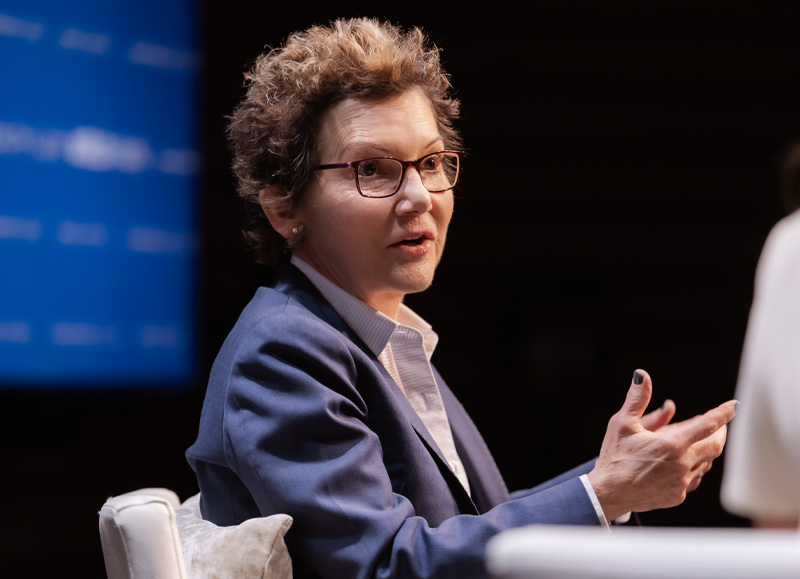
The Forum Club of the Palm Beaches recently hosted a fascinating interview with San Francisco Fed President Mary Daly, and I wanted to share some key takeaways with a particular spotlight on the labor market. I’ve spent 20-plus years in recruiting, and what Daly said about AI’s effect on hiring hit close to home. Her comments have only gotten more relevant since.
Key Takeaways
- The Fed held rates at 3.50-3.75% in March 2026, with only one cut projected this year (Federal Reserve, 2026)
- US payrolls fell by 92,000 in February 2026, with unemployment rising to 4.4% (BLS, 2026)
- Daly warns AI is creating a “transition dynamic” where companies pause hiring to figure out how AI fits their workforce
- Credit card debt hit $1.28 trillion, a record, with delinquencies at a 14-year high of 12.41% (NY Fed, 2026)
- The World Economic Forum projects AI will create 170 million new jobs by 2030 while displacing 92 million (WEF, 2025)
Table of Contents
What Are the Fed’s Top Priorities Right Now?
The Federal Reserve kept interest rates steady at 3.50-3.75% on March 18, 2026, with officials projecting just one rate cut this year (Federal Reserve, 2026). This matters for hiring. When Daly spoke at the Forum Club, the Fed was still trying to cool inflation without wrecking the job market. That balancing act hasn’t changed.
GDP growth slowed sharply to 0.7% in Q4 2025, down from 4.4% in Q3 (BEA, 2026). The economy grew just 2.1% for the full year. When someone asked Daly what the next rate decision would be, she said to keep an open mind. That got a laugh from the audience. But behind the humor? Real caution.
The Fed revised its 2026 growth forecast down to just 0.9%, signaling they see a bumpy road ahead (CNBC, 2026). For employers, that means planning for slower conditions. For job seekers, it means patience.
Is the Fed Really That Divided on Policy?
Seven of the 19 FOMC participants now expect rates to stay unchanged all year, one more than in December’s projections (Federal Reserve, 2026). Meanwhile, Fed Vice Chair Michelle Bowman has penciled in three cuts (Fox Business, 2026). That’s a big spread.
Daly’s answer at the Forum Club was clear: no, the Fed isn’t more divided than usual. The high consensus during COVID was the anomaly. She emphasized that healthy debate, like what we saw in 2019, is what actually drives good policy.
From my seat in recruiting, I’ll add this: the disagreement matters less than what they agree on. They all see a labor market that’s cooling. They all see AI reshaping how companies hire. The question is just how fast.
How Does the Fed Actually Gather Its Data?
The Fed draws from three pillars: government statistics, business surveys, and direct conversations with companies about their plans. Amid what Daly called “data fog,” they lean harder on real-world conversations. She’s not wrong about the fog.
US payrolls fell by 92,000 in February 2026, a surprise to most economists (BLS, 2026). Unemployment ticked up to 4.4%, with 7.6 million Americans out of work. Labor force participation dropped to 62%, its lowest since December 2021.
Here’s what the numbers don’t always capture: the people I talk to every day. Candidates who’ve been searching for three, four, five months. Employers who have open roles but keep pushing back start dates. The data shows “some softness,” as Daly put it. On the ground, it feels like more than that.
How Is AI Actually Changing the Job Market?
Forty-one percent of employers globally plan to reduce headcount using AI, according to the World Economic Forum’s 2025 Future of Jobs Report (WEF, 2025). But the same report projects 170 million new jobs created by 2030, against 92 million displaced. Net positive. So which is it?
Both. And that’s exactly what Daly described at the Forum Club.
AI has two faces. It drives stock prices up. But it starts real fights between people who fear massive job losses and people who love the technology. In a February 2026 speech at San Jose State University, Daly used the phrase “transition dynamic” to describe what’s happening right now: companies are holding off on hiring because they’re trying to figure out how AI fits into their workforce (Axios, 2026).
I see this every week in my recruiting work. Employers aren’t cutting jobs outright. They’re just… pausing. Waiting. Trying not to hire the “wrong workers” before they know what AI can handle. That hesitation ripples through the entire market.
Think of AI like electricity or the steam engine. It could change everything. Daly used the physician’s assistant example, which I found compelling: a PA uses AI to ask diagnostic questions, helping address doctor shortages without replacing the doctor. That’s augmentation, not replacement. And the data backs it up. Ninety-four percent of physicians now report using or wanting to use AI, with daily usage jumping from 47% to 63% in just one year (Doximity, 2026).
But past tech shifts, like the rise of computers, did eliminate entire categories of mid-level jobs. We have to watch this carefully.
What Does the K-Shaped Recovery Mean for Workers?
Credit card debt hit a record $1.28 trillion in Q4 2025, up 5.5% from the year before, with the average American carrying $6,360 in balances (NY Fed, 2026). Serious delinquencies, balances 90-plus days past due, climbed to 12.41%, the highest rate in more than 14 years.
Daly’s description of the K-shaped economy holds up. The top half is doing fine. Spending by the top 10% grew 62% between Q3 2020 and Q3 2025, far outpacing every other income group (Minneapolis Fed, 2026). The bottom half? They burned through their COVID savings. Inflation ate into what was left.
Just 19% of Americans ended 2025 with more emergency savings than they started with, and those were mostly households earning $100,000 or more (KBTX, 2026). The national savings rate sits at 4.6%, well below the 40-year average of 6.4%.
What does this look like in my world? Candidates who can’t afford to wait for the right role. People taking lower pay just to have something. And employers who know this, which sometimes affects what they offer. It’s a tough dynamic.
What’s the Real State of the Economy?
GDP grew just 0.7% in Q4 2025, dragged down partly by a government shutdown that subtracted a full percentage point from growth (BEA, 2026). The Fed revised its 2026 forecast to 0.9% growth. Those aren’t recession numbers, but they aren’t comfortable either.
The economy is good overall. But it’s more vulnerable than headline numbers suggest. Daly’s personal story drives this home. She dropped out of high school to help her family during a downturn. She later earned her GED and eventually a PhD in economics. She emphasized that no matter what the data shows, the economy is about people.
In March 2026, she warned that “labor market weakness shows persistent risks” to the Fed’s dual mandate of stable prices and maximum employment (Bloomberg, 2026). That language matters. “Persistent risks” isn’t something Fed officials say casually.
What Does Mary Daly Actually Do at the San Francisco Fed?
As San Francisco Fed President, Daly runs an organization with 1,800 employees. She handles cash flow and digital payment systems. But the part that stood out to me was how much of her job involves listening: talking to business owners, workers, and community members, then bringing those stories to the Federal Open Market Committee.
Her February 2026 speech made this point directly. She argued that the Fed won’t find answers just in aggregate data, and that “seeing developments before they fully emerge requires digging deeper, relying on disaggregated information” (SF Fed, 2026). In other words, talk to real people. As a recruiter, I couldn’t agree more.
What Should We Watch Going Forward?
On picking the next Fed Chair, Daly was direct: it won’t change their work. The Fed stays independent and follows the data.
But here’s what I’m watching from the recruiting trenches. Will AI’s “transition dynamic” break, meaning companies finally start hiring again with clearer AI strategies? Or does this limbo stretch through 2026? The WEF’s projection of 78 million net new jobs by 2030 is encouraging, but those jobs won’t appear overnight. And they’ll require different skills.
Seventy-seven percent of employers plan to upskill their workforce for AI, rather than just cutting heads (WEF, 2025). That’s the signal I’d hang my hat on. Companies that invest in their people through this transition will come out ahead. The ones who freeze? They’ll fall behind.
What do you think? Will AI boost productivity without making inequality worse? Or does a softening job market mean bigger changes are on the way?
Frequently Asked Questions
How is AI affecting hiring in 2026?
Many employers are pausing hiring decisions while they evaluate how AI fits their workforce. San Francisco Fed President Mary Daly calls this a “transition dynamic” where companies fear hiring the “wrong workers” before understanding AI’s role. The WEF projects 170 million new jobs created by 2030, but the transition period is creating uncertainty for both job seekers and employers.
What is the current US unemployment rate?
The US unemployment rate rose to 4.4% in February 2026, with 7.6 million people unemployed. Nonfarm payrolls unexpectedly fell by 92,000, and labor force participation dropped to 62%, its lowest level since December 2021, according to the Bureau of Labor Statistics.
What does K-shaped recovery mean?
A K-shaped recovery describes an economy where high-income earners recover and thrive while lower-income households fall further behind. In the current economy, spending by the top 10% grew 62% since 2020, while lower-income Americans face record credit card debt of $1.28 trillion and a 12.41% serious delinquency rate.
What is the Federal Reserve’s current interest rate?
The Federal Reserve held rates steady at 3.50-3.75% at its March 18, 2026 meeting. Officials project one rate cut in 2026, though there’s disagreement: seven of 19 FOMC participants expect no cuts at all, while Vice Chair Bowman has penciled in three.
Will AI replace recruiting jobs?
Based on current trends, AI is augmenting recruiting rather than replacing it. Tools help with resume screening and candidate matching, but relationship-building, cultural assessment, and complex negotiations still require human judgment. The WEF identifies creative thinking and analytical skills as the fastest-growing capabilities in demand.
Originally published November 5, 2025. Updated March 26, 2026 with latest Federal Reserve data, February 2026 jobs report, and Mary Daly’s recent remarks on AI and the labor market.
John Brandes is a recruiter and founder of SalesBountyHunter with 20+ years in talent acquisition. Follow him on LinkedIn for recruiting insights.